

Disclaimer: All thoughts expressed here are my own and are not representative of my employer in any capacity.
Introduction
Cell Survivor, developed by Japanese studio SkyFury Technology, is a roguelite survivor-castle defense hybrid that is currently generating approximately $300K in daily revenue, with the majority of it coming from Japan and South Korea and the US growing fast as a western market.
At a glance, it looks like a typical asian gacha game in terms of it UI design, User experience and crude English translations, yet the game is pulling serious numbers and finding an increasingly wide audience.
This combination of strong monetization, deliberate design choices that break western conventions, and a growing crossover into western markets makes Cell Survivor a genuinely interesting case study.
This article specifically is about analyzing Cell Survivor holistically as a product, and not specifically focussing on design elements which are already established in the industry by the genre.
A Market Snapshot
Before getting into the game itself, the market data is worth spending a moment on.
Japan leads both downloads (18.5%) and revenue (43.7%), with South Korea adding another 12.7% of net revenue. Together they account for over half the game’s total revenue from less than a quarter of its downloads indicating high ARPDAU. This isn’t a volume game for its core market. It is a deep-spend game built for an audience that is very comfortable with the genre conventions being used.
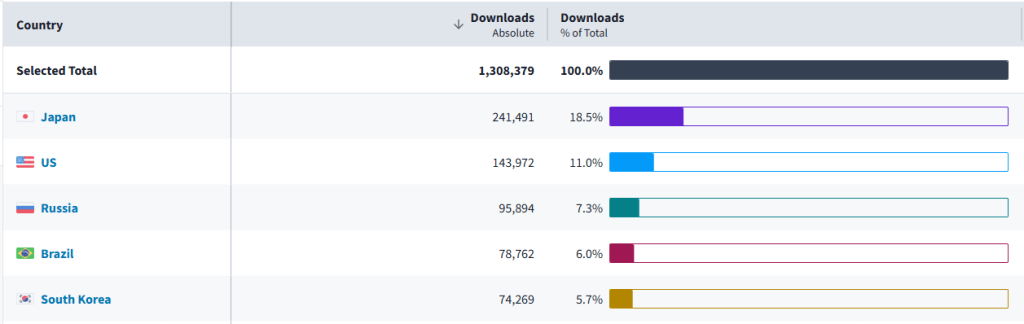
The US sits at 16.6% of revenue and 11.5% of downloads, which puts it roughly in parity, but meaningful because it confirms the game is finding traction in a market that wasn’t its primary target. Germany and the UK also feature, suggesting organic spread rather than a deliberate western push.
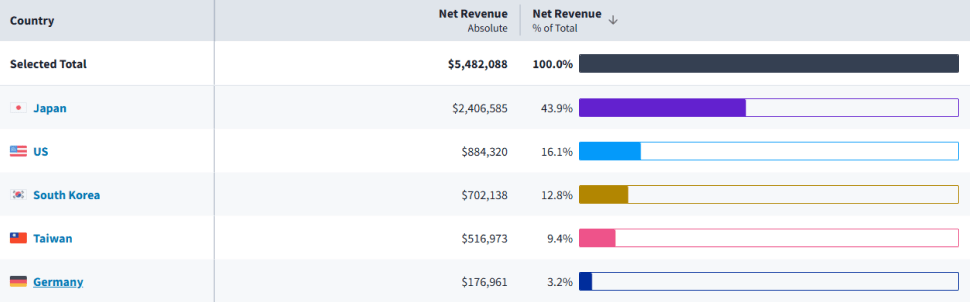
The takeaway here, Cell Survivor’s design choices are not accidents or oversights. They are tuned for a specific, high-value player who knows exactly what they are doing, and the western growth is happening in spite of or arguably because of how uncompromising those choices are.
The Core Loop
The player’s primary goal in Cell Survivor is to raise their Combat Power. Every action in the game, in-session and in the meta is oriented around this goal. There is no secondary aspiration competing for attention.
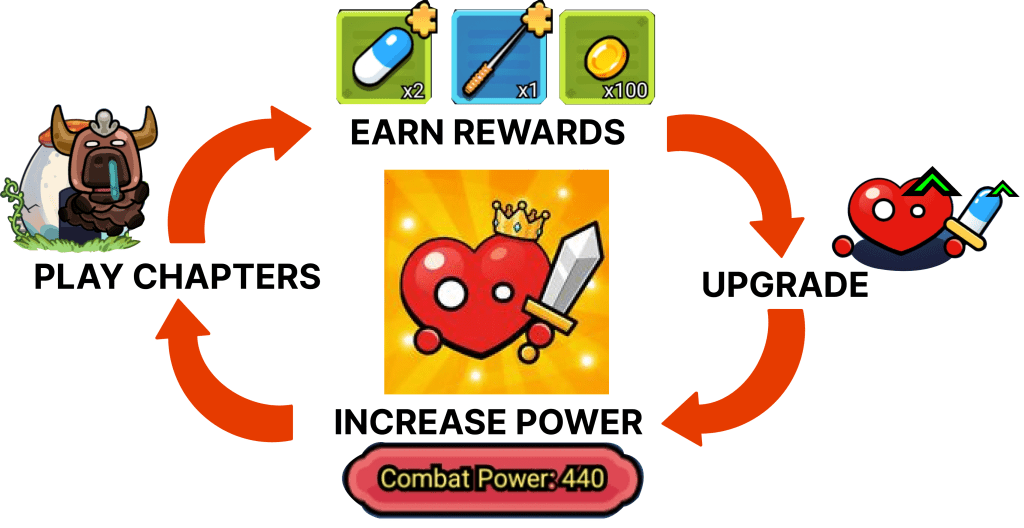
This is a straightforward power progression loop and its clarity is actually one of the game’s strengths. Players always know what they are working toward. There is no ambiguity about progress. Combat Power is the score, and everything feeds it.
Gameplay
The gameplay itself is deceptively simple in its premise, kill enemies before they reach you. A single impending danger approaching and your goal is to kill it. The skill ceiling isn’t only in manual aiming since most of the combat is effectively automated, but also in the decisions that shape how capable your character is before and during a run via roguelite mechanics and deck building with weapons.

At specific progression checkpoints during a run, players open chests that offer a choice of weapon upgrades or stat modifications. Every choice is fundamentally a DPS optimization problem. The primary goal of each decision is to maximize damage output, which determines how far into a chapter you can progress before the enemy HP overwhelms you.

Meta Systems
The meta is built around four distinct progression vectors, each of which routes back to Combat Power through a different path:
Character Upgrades are the primary power lever. Investing coins into character stats directly increases Combat Power. This is the most direct path, and it’s a coin sink. It is interesting to note here that the Character upgrade system is unsophisticated compared to the typical 4-5 slot gear system. This could be owing to the game’s WeChat origins.

Weapon Upgrades serve a dual purpose. Upgrading weapons increases DPS in-session and critically, unlocks more choices when chests are ‘opened’. More weapons in your collection means more options during play. Weapon upgrades are done with shards but don’t cost anything, but require gems to acquire via gacha. The weapon deck system allows you to take the best combination of weapons into battle, influencing the choices your are given.
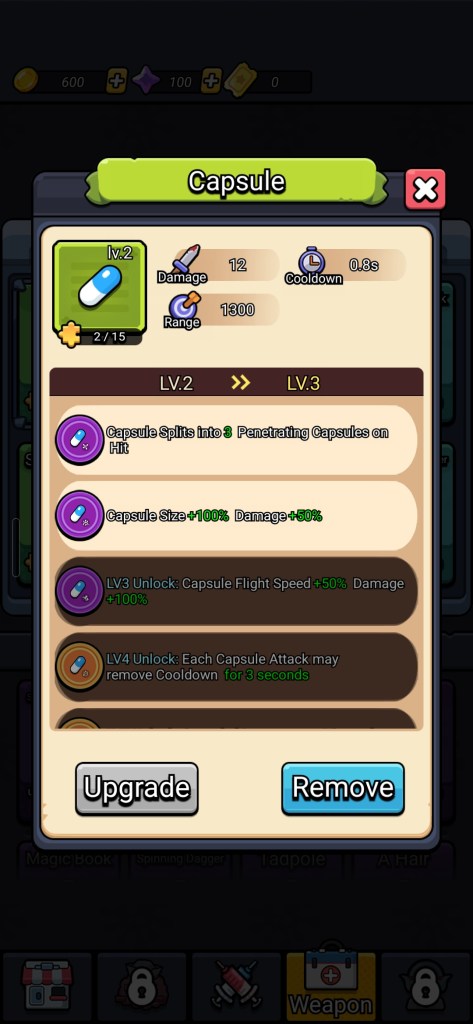
Artifacts are the long term collection system. They provide passive stat bonuses and set bonuses for completing collections. They are also monetized similarly via an extensive gacha system, acting as the longer term, compounding power progression goal for the players
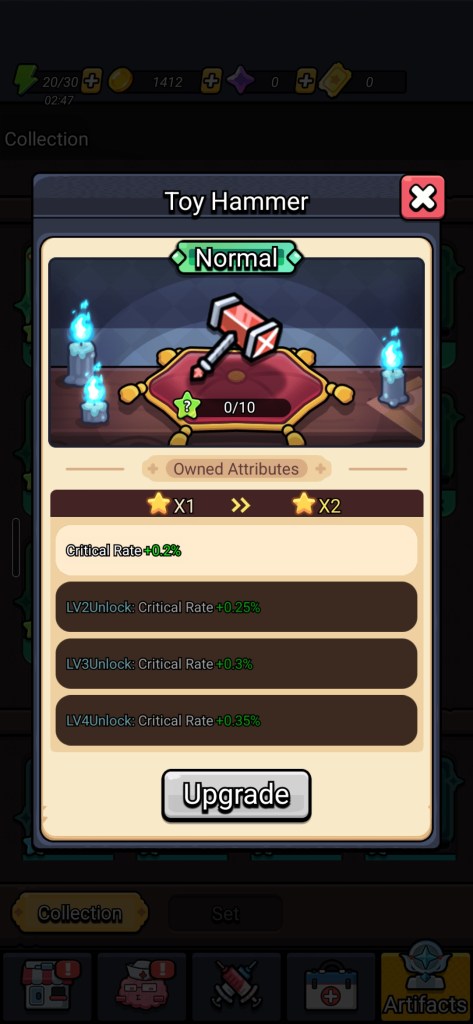
The game features quite a lot different gacha mechanics, such as the pity systems,evolving gacha mechanics, fragment exchanges, roulette pulls among other things to ensure continuous engagement with the gacha system over long periods.

Skins are explicitly a payer and whale system. Unlike cosmetic skins in western games, skins in Cell Survivor carry gameplay modifiers. It functions here as a high ceiling spend option for players who want power alongside cosmetics.

Meta Features
The features surrounding the meta systems are designed around one primary behavior: daily resource accumulation to feed the gacha loop.
Sweep lets players auto-complete previously cleared chapters for rewards without replaying them, which keeps daily engagement high without requiring full gameplay sessions. Idle Chests , Daily Tasks, Instances, and Events all route to the same destination,gems and coins for the daily resource grind, which then flows into gacha pulls, which drive the core loop.
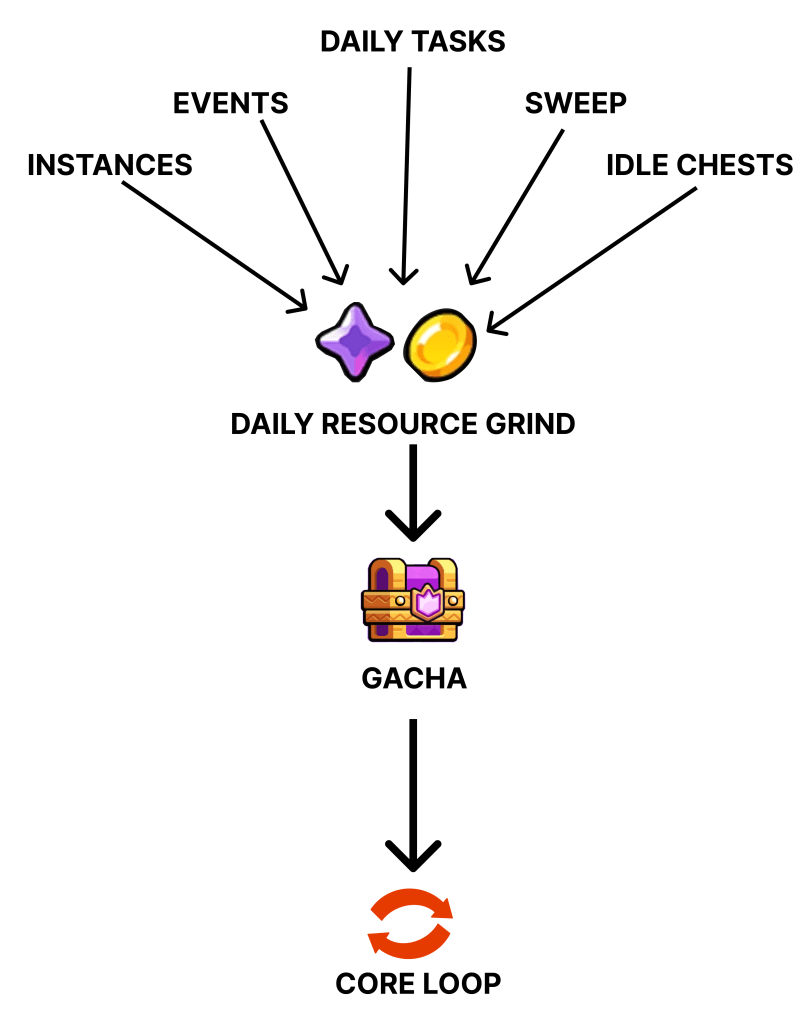
The architecture is straightforward, meta features exist to maximize daily resource generation, which in turn maximizes repeat gacha spend. What’s notable is how intentional the funnel is. Each one serves a purpose in the resource flow.
Monetization
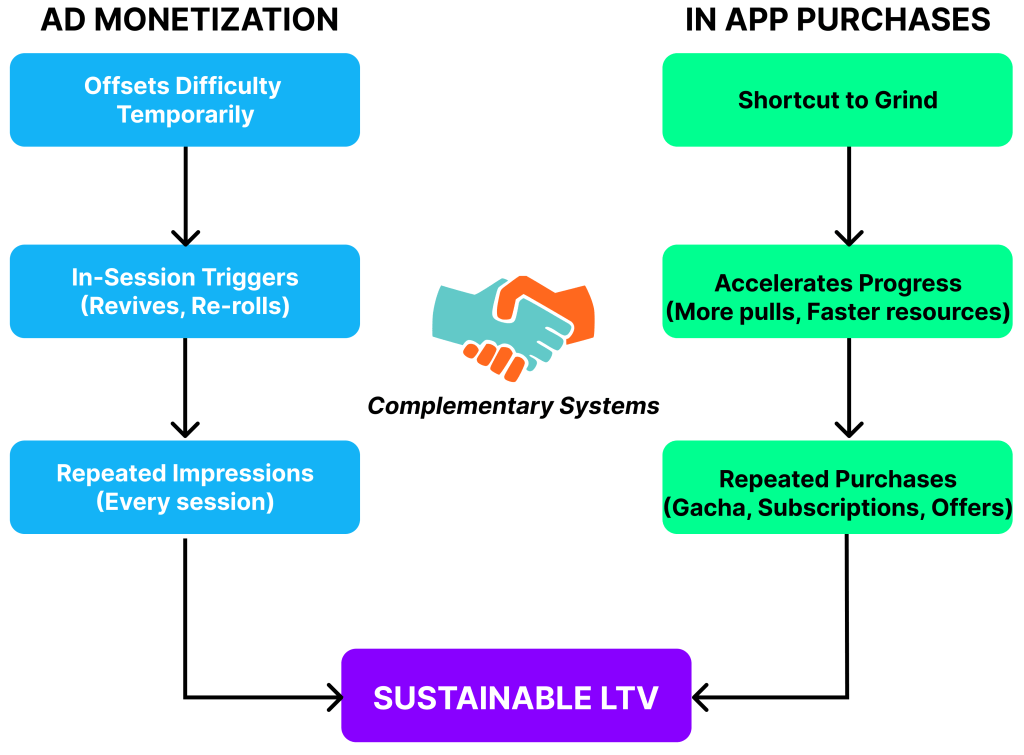
The monetization model in Cell Survivor is worth examining because it does something that many F2P games fail at, it makes IAP and ad monetization genuinely complementary rather than competing systems.
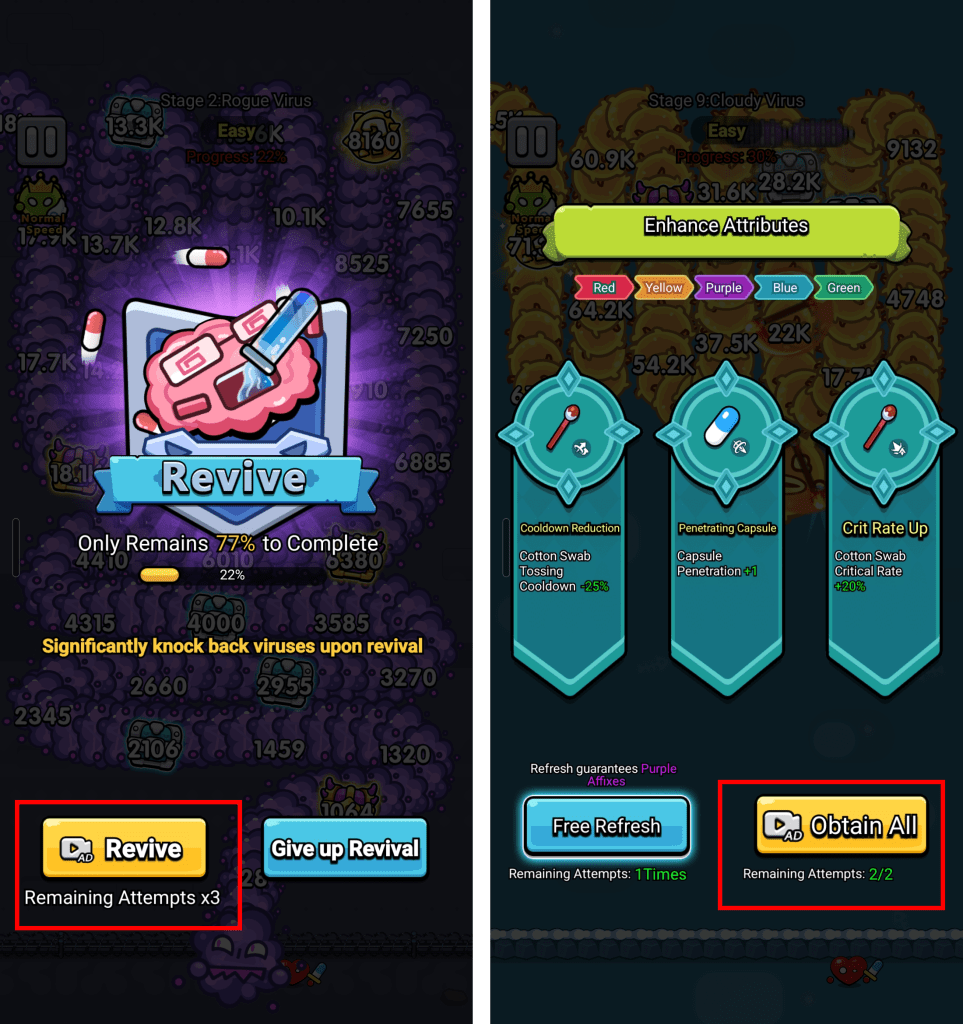
Ad monetization operates during in-session critical moments, revives, rerolls at chest decision points, multi-obtains. These placements are limited in number per session, which preserves their value. Because they are capped and tied to meaningful decision moments. They are repeatable every session, which means consistent daily impression volume, and they don’t alienate payers because the advantages they offer are temporary and session-scoped.
IAP monetization operates at a different level entirely. Crucially, IAPs don’t offer direct solutions to a power problem. Nothing in the shop guarantees the outcome a player wants. What IAPs do is remove the time and grind standing between a player and that outcome. This distinction matters because it means the game can charge for acceleration without breaking the integrity of the progression system. Players who pay reach the same place faster and they don’t skip to a destination that non-payers can never reach.
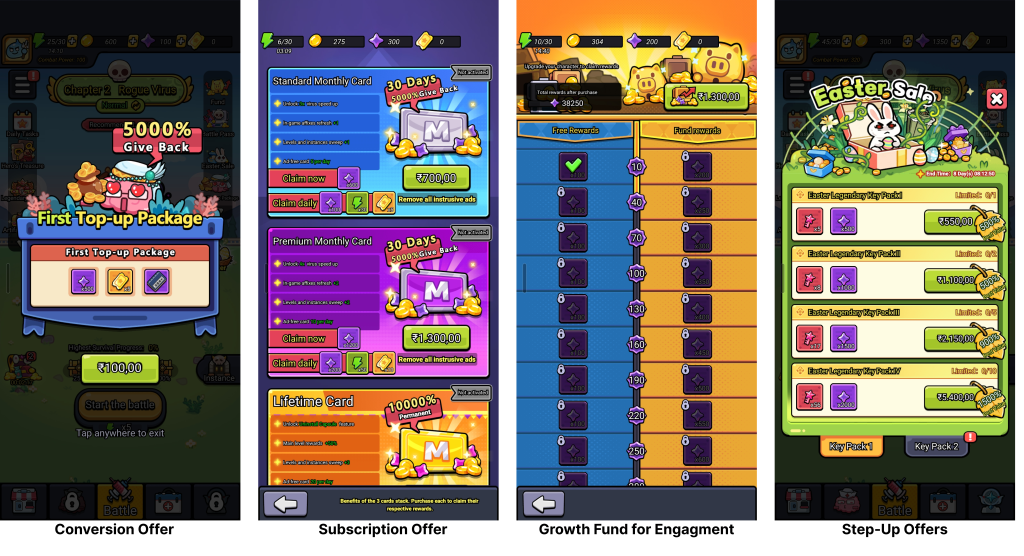
The IAP product suite is structured across three behavioral objectives, first conversion (low-barrier entry offers to get a player’s first purchase), repeat conversion (subscription products, gacha pulls, regular offers timed to events), and price step-up (escalating value offers that move players up the spending ladder). This is a thoughtful product architecture rather than a menu of items, and it reflects a clear understanding of payer lifecycle.
The net result is a system where ad watchers, casual payers, and whales all have a defined role and don’t step on each other. Ad revenue from non-payers is consistent and high-impression. IAP revenue from payers is protected and has clear ceiling expansion via the skin system. The two streams coexist without the ad experience making the IAP feel unnecessary or the IAP experience making the ads feel beneath the product.
Live Operations
Liveops in Cell Survivor operates on two timeframes with two distinct goals.
Daily liveops are focused on enhancing monetization through the gacha system. Legendary Chests and Artifact Chests refresh on a schedule, giving players regular new reasons to spend accumulated resources. This isn’t content — it’s a monetization cadence system that ensures the gacha sink stays active even between major events.

Seasonal events take a more interesting design approach. They operate independently of a player’s Combat Power, which means the playing field is normalized for the duration of the event. This is a deliberate design choice, and its logic is clear. By removing the payer advantage that defines the core game, seasonal events create a new revenue stream that captures spend from players who wouldn’t otherwise be willing to pay into an uneven power system. It’s a clean way of expanding the monetizable audience without disrupting the core economy.
Strengths
IAP and Ad monetization genuinely complement each other. The architecture of when and how each system is presented means they serve different player behaviors without cannibalizing each other. This is harder to achieve than it sounds.
The player goal is clear and consistently reinforced. Combat Power is the north star, and every system in the game points toward it. Players never have to ask what they should be doing or why. That clarity keeps the funnel tight.
The gacha mechanics are sophisticated. Pity timers, fragment exchanges, refreshing content, evolving rarity pools. The gacha systems in Cell Survivor are layered in a way that sustains long term engagement and repeat spend. There is always a path forward even without luck.
Spend depth is significant and layered. The existence of multiple meta systems (character, weapons, artifacts, skins) with different resource economies means the monetization ceiling is high and different payer archetypes have natural entry points. IAPs never sell the thing itself, only the acceleration which ensures a stable and growing LTV.
Weaknesses
All strategies converge on maximum DPS. The roguelite layer promises decision depth, but in practice every choice at every chest is evaluated by the same criterion: which option increases damage output most. There is no meaningful reason to build around anything other than DPS, which means the decision moments that should be the most interesting part of the game are reduced to a single-axis optimization problem.
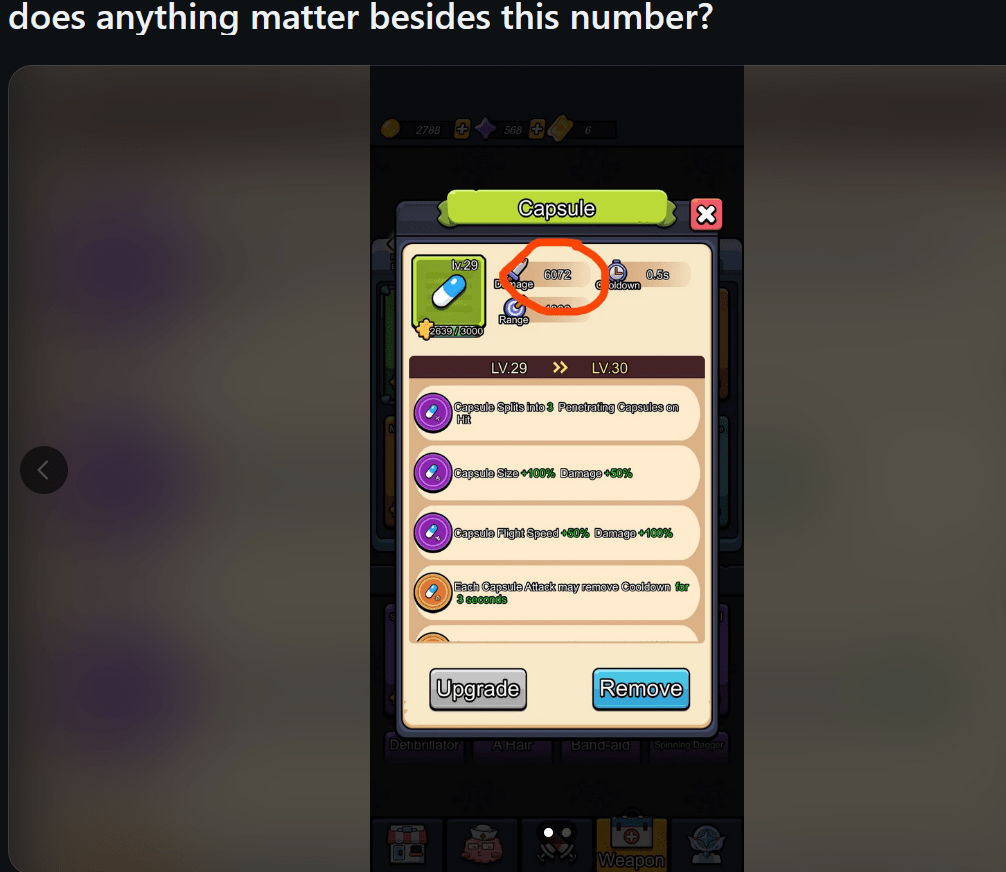
Primary power progression is too narrow. Character upgrades, which are the main driver of Combat Power, are limited primarily to Attack stat improvement and are gated behind coin accumulation. This creates a bottleneck that funnels all player attention toward a single resource and a single upgrade path at the expense of the weapon and artifact systems, which have considerably more spend depth but less pull as long as Attack is the dominant lever.
The weapon system is structurally underutilized. Weapons exist to increase DPS and expand in-session chest choices. Beyond those two functions there is no compelling reason to engage with the weapon roster broadly. The DPS-centric meta means players will naturally gravitate toward unlocking the highest-rarity weapons in their preferred damage archetype and stop there. Post-unlock, the incentive to continue investing in weapons which is where significant gacha spend depth lives, drops substantially.
Roguelite choices lack strategic emergence. One of the core pleasures of roguelites is the emergent gameplay that comes from combinations, the moment where a build suddenly clicks and produces something amazing. Cell Survivor’s choices don’t generate these moments. Everything is damage-focused, so there are no meaningful synergies to discover and no possibility of a creative solution overcoming a power deficit. The roguelite structure is present, but the strategic depth it should produce isn’t.
Conclusion
Cell Survivor is a deceptively well made game that is doing most of the important things right. The core loop is coherent and tightly focused, the monetization architecture is genuinely thoughtful in monetizing it’s niche audience that has very specific expectations and wants.
The weaknesses it carries are real, but they are specific. The DPS centric meta and the narrowness of the character upgrade system create a ceiling on both gameplay depth and monetization potential that doesn’t need to be there. The weapon and artifact systems have the architecture to carry significantly more engagement and spend but they’re not being given a reason to. The game is leaving money on the table in systems it already built, maybe partly owing to its more simplistic origins.
Whether SkyFury addresses this or not, Cell Survivor is worth understanding for what it already is, a high performing example of Asian mobile game design at its most purposeful, finding an audience well beyond its intended market, on its own terms.


