

Disclaimer: All thoughts expressed here are of my own and are not official or representative of my employer in any capacity.
Introduction
Rainbow 6: SMOL is an isometric roguelite shooter developed by Ubisoft and released on February of this year as a Netflix exclusive title on iOS and Android.
As a F2P game designer, Premium games offer an opportunity to experience and analyze mobile games where monetization was not used to dictate decisions around game mechanics and system design, which in turn lets us focus on the gameplay and other mechanics centered around engagement and retention aka ‘fun’.
It also goes to say one of the reasons this game was specifically chosen is just because it is one of the few premium games that successfully captured my attention and time. And to my delight, it was time well spent.
In a bid to understand why this game managed to capture my attention in the way it did, we come to this particular article here. So, what’s so great about Rainbow 6 : SMOL?
The Connection with the Rainbow 6 IP
The traditional Rainbow 6 Franchise is known to be a realistic, first person tactical shooter with destructible environment and class-based gameplay via Operators.
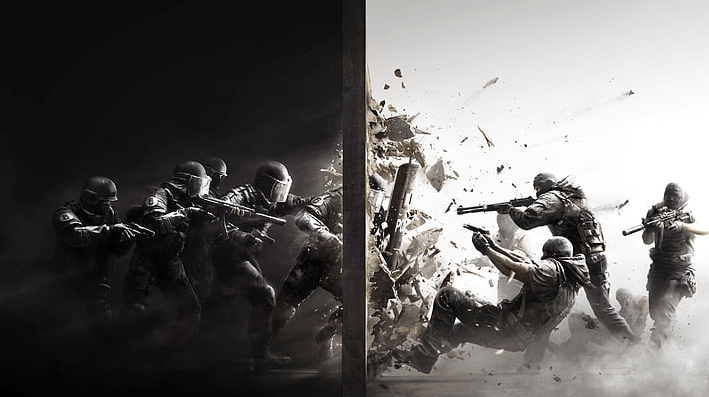
Rainbow 6: SMOL takes a bit of a deviation from this traditionally hardcore, AAA console/PC focused formula (And rightfully so in my opinion) and brings it’s own whimsical take on this franchise with a more mobile friendly isometric, roguelite shooter with a much more casual art style. It also maintains its ties to the original R6 IP through,
Player Classes: In R6: Siege, players pick operators which represent different playable classes through skills and in R6: SMOL, there are generic pre-defined player classes.

Destructible Environments: Another recognizable trait of R6 games are the destructible environments that are integrated in R6:SMOL with purposeful intention, so much so that there is a dedicated button to kickdown doors among other things.
Operators : Instead of being playable characters, Operators in R6: SMOL are NPC’s that assist the player in the core-game with separate NPC skills. Anyone familiar with the franchise will be able to identify these operators (Along with some background lore!)
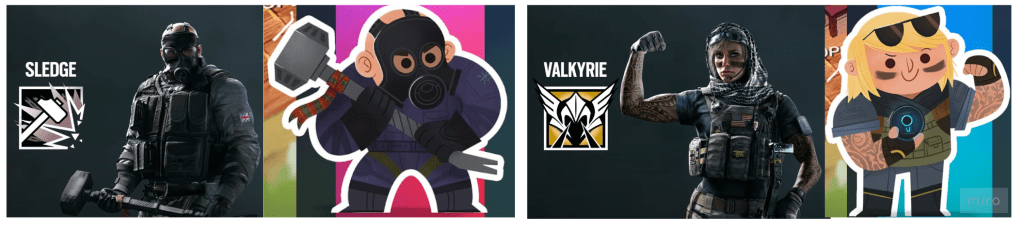
However, it is interesting to note that before the game got the R6 IP, it was already out in the market as ‘Tiny’, published by Cloudsome games (A white label for Ubisoft probably) about 2 years ago.

Gameplay
R6: SMOL deviated from the standard practice from being a direct port (Of which there is an actual F2P version of, already) and instead went for a relatively more casual, roguelite shooter that is still rooted in the tactical shooter space, albeit a more approachable one.

The reasoning behind this decision could be driven by one of many such as the platform, monetization model or it could even be an experiment by Ubisoft for a more casual Rainbow 6 game in an attempt to get more eyes and potentially more interest in the Rainbow 6 IP, where it can safely gauge the interest the game generates in an isolated platform without the possibility of turning away the more hardcore fans from a relatively more financially guaranteed F2P port.
Core Loop
Speculations aside, in R6:SMOL a player
- Starts by picking a character class to load into a map. The objective is to ‘liberate’ a map by completing a set of missions inside the map.

- Pick a Region and Operation from the map to ‘liberate’.

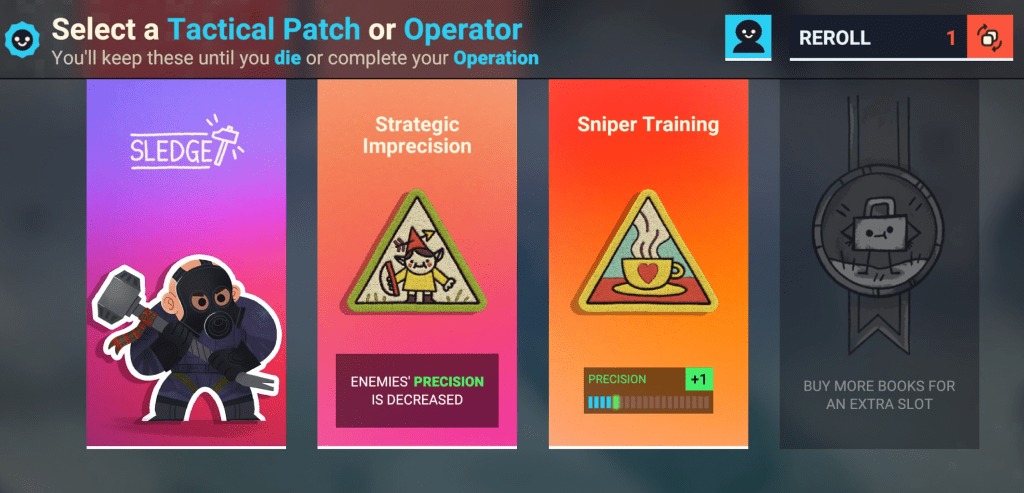
- Chooses between multiple perks at the start of an Operation which could be various stat boosts or NPC squad members (Operators).
- Collects Skill points while on Operations by killing enemies and completing Objectives and use these points to level up and improve their stats temporarily or unlock permanent perks for the character class.

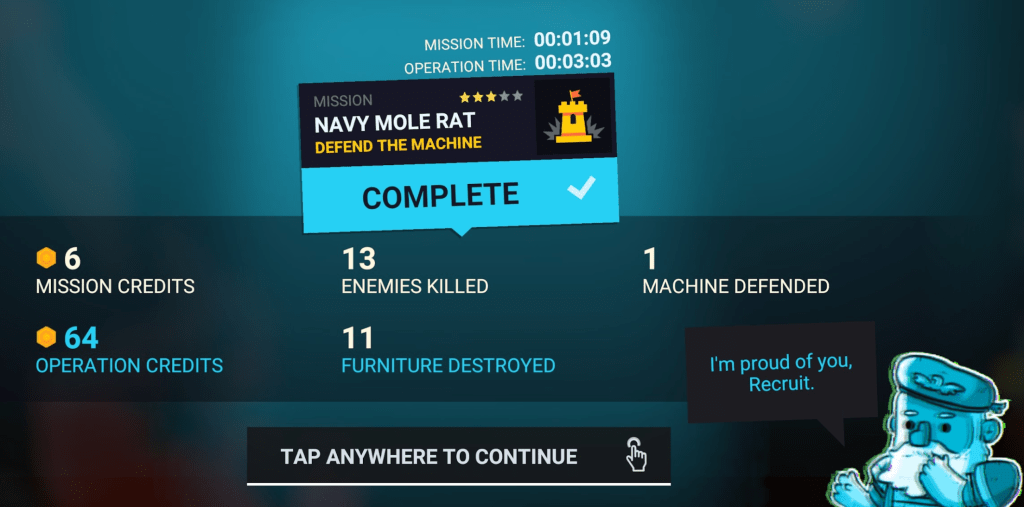
- Extract Credits by completing missions which are used to grant permanent global stat upgrades (Not tied to a class).
If a player dies during a mission before liberating a map, they lose all their stats, perks, accumulated currency and need to start over with a new character (And class). The type of class chosen on respawn is random.

Gameplay Experience
The game is played in landscape, with an isometric camera. It features a unique and whimsical art style which is accompanied by an equally whimsical UI, UX and Audio design.
You could argue that it is a complete contradiction of player expectations from the IP. But for someone like me who has never played a Rainbow 6 game before, this approach to the visual aesthetic was fun, refreshing and a large contributing factor to actually playing the game.
Controls
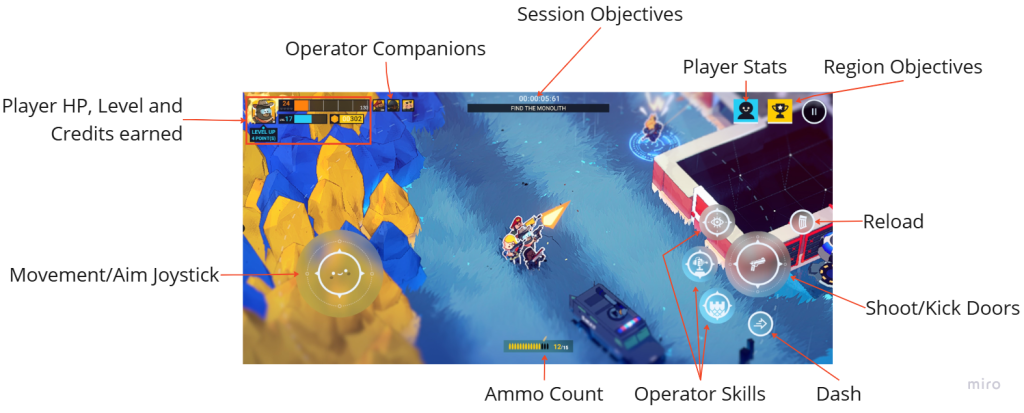
Operator skills also appear on the right side when the player has Operators accompanying them. So far, I was able to have 3 operators with me in a mission, but the UI seems to be able to accommodate up to 4.
The combination of movement and aiming controls makes the game a lot more arcade-y, and the general gameplay with very chaotic . In later stages of the game, there are options to automate the shooting so that you can focus on using the operator skills and moving the character around.
Environment Design
True to the original IP, R6: SMOL features destructible environmental elements with an especially addicting ‘Door bust’ mechanic.
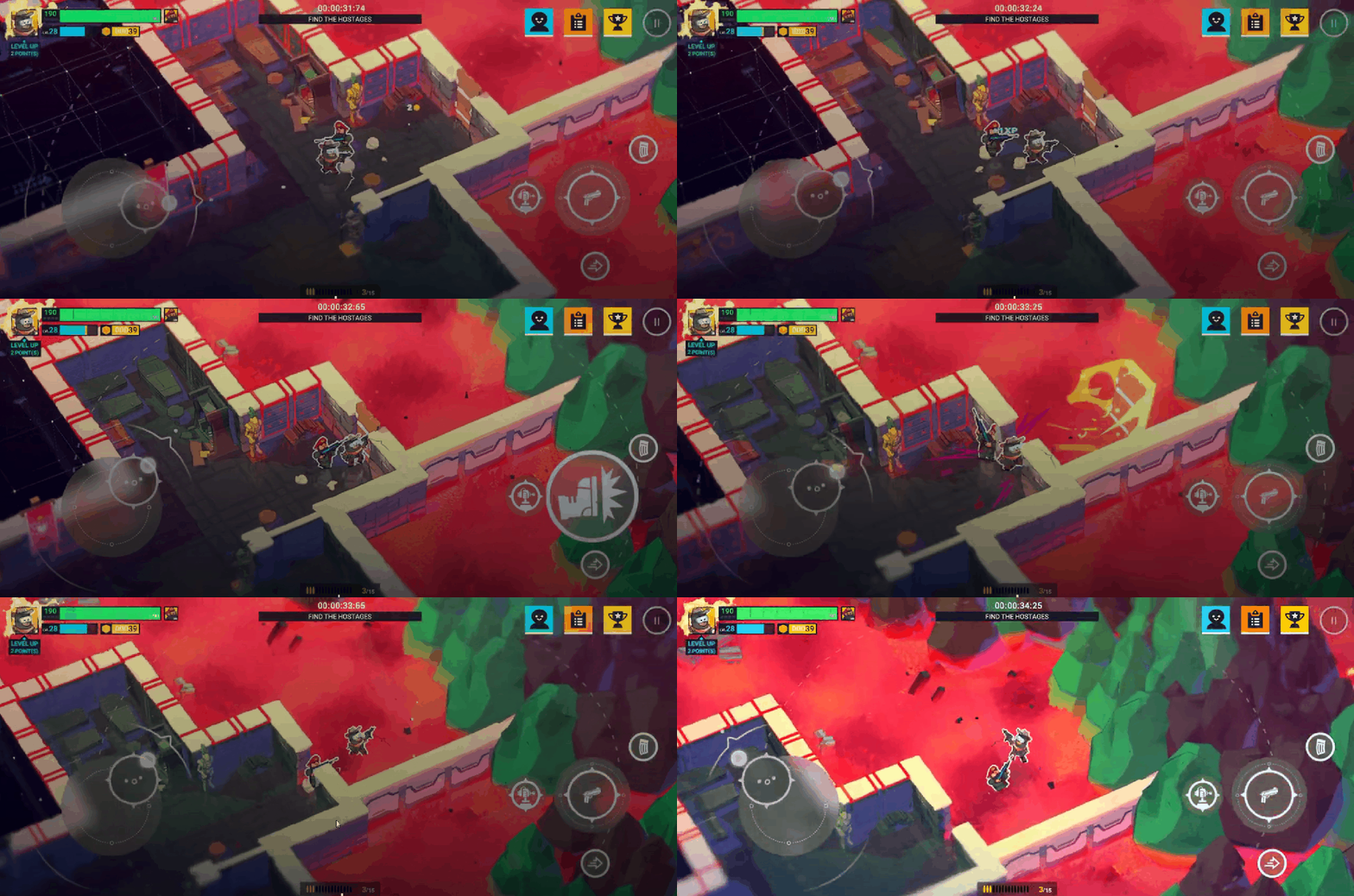
Certain operators like Sledge can carve shortcuts for you with their wall breaking ability.
Besides breakable walls, the game also features environmental traps that adds a bit of platforming at certain points of the game, though it’s almost always optional.

The environment also brings opportunities for stealth via the fog of war, footstep detection and booby traps.
The maps also strewn with credits and in-game lore snippets to encourage exploration.
In summary, R6: SMOL sits in intersection of tactical shooters, action roguelite and bullet hell by borrowing mechanics from those genres to deliver a casual and fun roguelite experience.

Progression
There are multiple progression vectors in R6:SMOL, each of which represent a specific part of the game system. Most notably via,
- Map
- Character Classes
- Operator
- Patches
Map
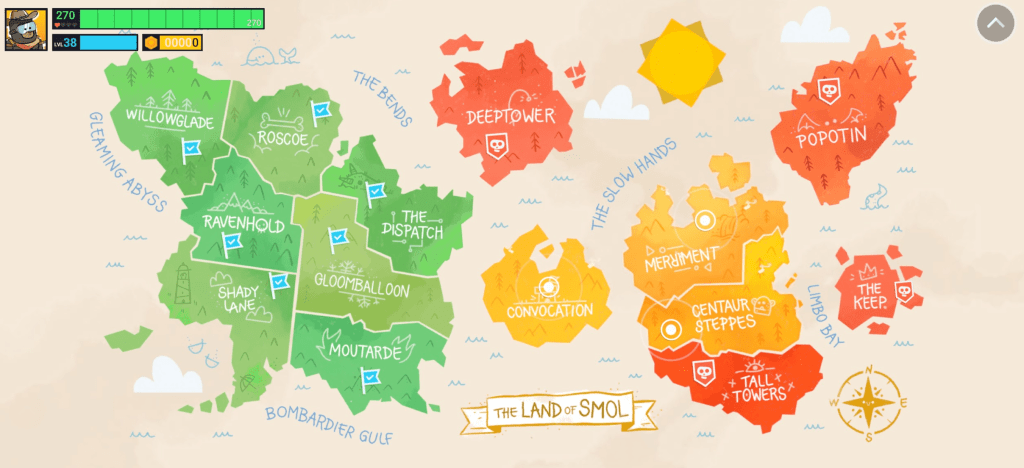
The content progression of the game is visualized through the map. The map is divided into continents which contain countries, which in turn is comprised of multiple regions.
Each region consists of multiple series of nodes, each node is called an ‘Operation’.
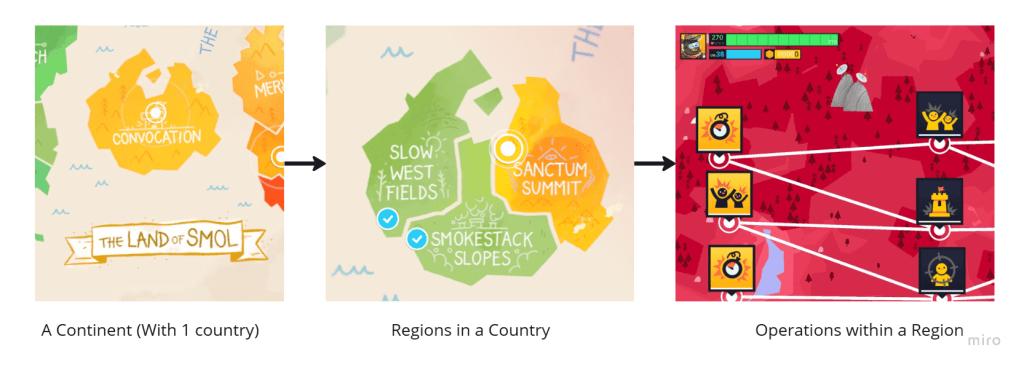
An Operation is represents a single gameplay session. The type of operation defines the objective for the session, there are multiple types, such as
- Assassination/Kill the Target
- Diffuse the Bomb
- Defend the Tower
- Save the Hostages etc.
A player unlocks new types of Perks (Pre-Session choices), Playable classes and Operators by completing Operations. It is the source of unlocking content in the game.
To complete a region, a player must complete a series of Operations. A player can choose what type of operations based on the different paths available in the map.
Failing an operation ends the session and closes that path. And the player has to find a different path to the end of the branch to complete the region, very much alike the map in Slay the Spire.
Failing also has other consequences like losing some of the earned credits, all accumulated patches, operators and Skill stats.
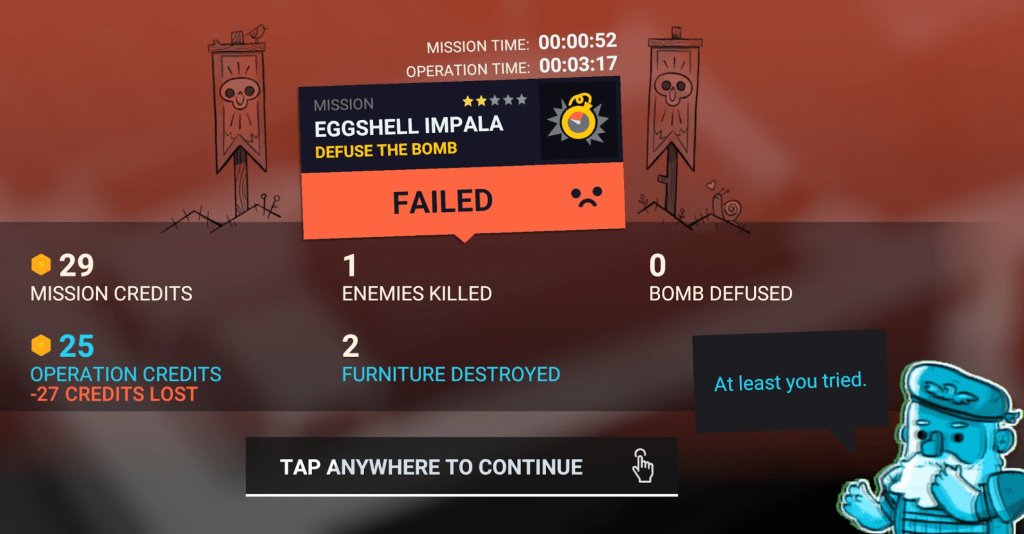
The paths often branch and intersect with each other and allows players to switch branches at junctions.
There is a possibility of spawning ‘Rest Zones’ at a node instead of an Operation where players can get free Mission Perks or Operators. These Rest Zones are unlocked by progressing in the Meta.
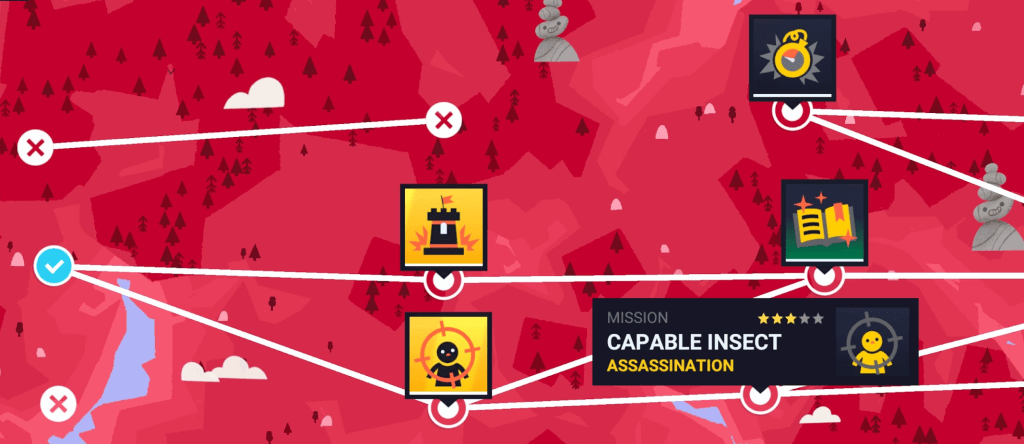
Normally, a player has to complete between 3-6 operations to complete a region. Completing a region unlocks new adjacent regions and completing all regions within a country unlocks a new country.

Completing all countries unlocks a new continent and so on.
Characters Classes
In R6:SMOL, player can choose to play between different classes. Once a player picks a class, they are locked into that class/character until death.
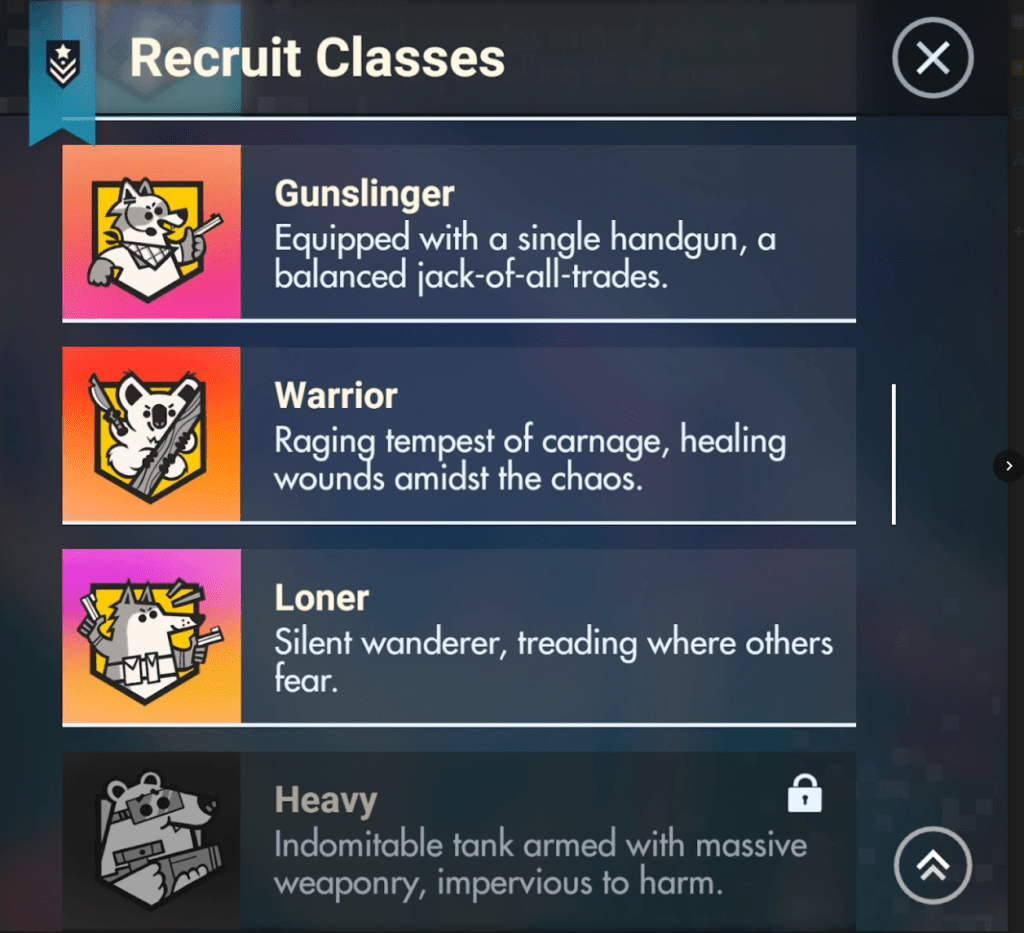
The classes differ in stats and weapons used. The weapons themselves differ in range, damage, spread and clip size.
A character can progress through two progression vectors and both of the vectors use the same resource, Skill points. Skill points can be invested in-session on either,
- Stats Upgrade – These stats are lost if the player dies, but in turn makes the character stronger for the current session, increasing the survival chances in the more difficult regions and countries.

- Class Upgrade – Class upgrades are permanent and are equivalent to ‘Mastery’ seen in other games. Investing points in the class unlocks new weapons and skins for the player to use for that class.
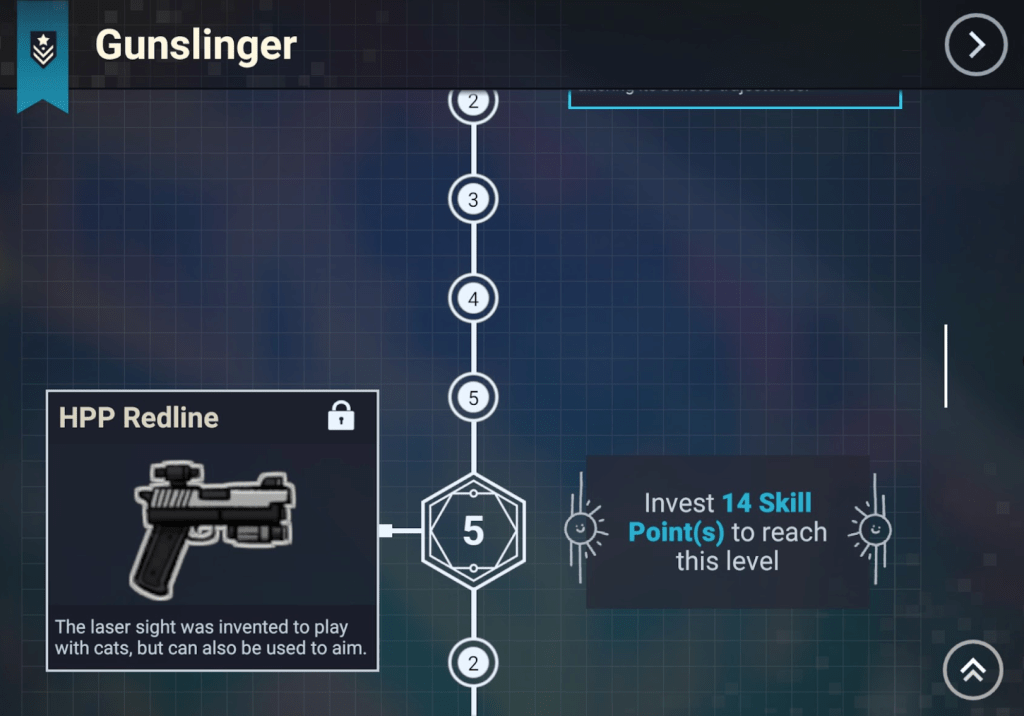
In a session, the player has to decide if they want to strengthen their character immediately via stats or opt to unlock new weapons to optimize the playstyle of the class.
There is a large variety of stats to invest the Skill points into. Besides the temporary stat boosts, stats can also be upgraded permanently from Books of Power, where the player spends Credits earned from Operations.

If a player dies while on an operation, they ‘lose’ the character along with all accumulated perks, operators and stats on it.
This system of changing class on death puts the player in a delicate position when it comes to deciding how to invest Skill points.
For this reason, a player has the option to ‘resurrect’ a past lost character with credits. The higher level the character is, the more expensive it is to resurrect them.

New class types can by unlocked by completing objectives in specific regions of the map.
Operators
In R6:SMOL, operators are NPC companions that the player can choose take with them on Operations.
They fulfill the role of Squad gameplay and add gameplay depth through the tactical use of their skills, which is inspired by their Rainbow 6 counterparts.
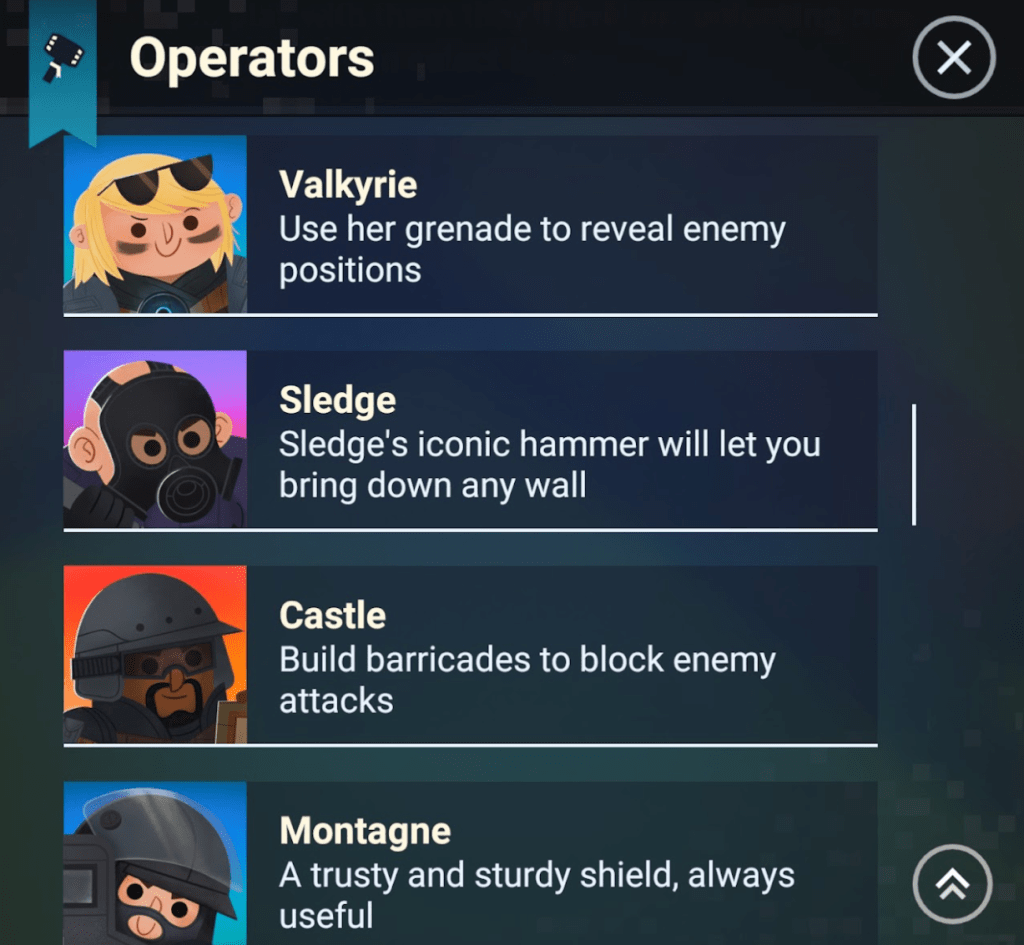
Operators have active (Abilities) and passive skills. Active skills are visible as buttons in the game while passive skills provide stat boosts to the player and other Operators in the squad.

Operator can be upgraded by completing Operations with them. Upgrading Operators unlocks new active skills, passive skills, skins and equipped weapons.
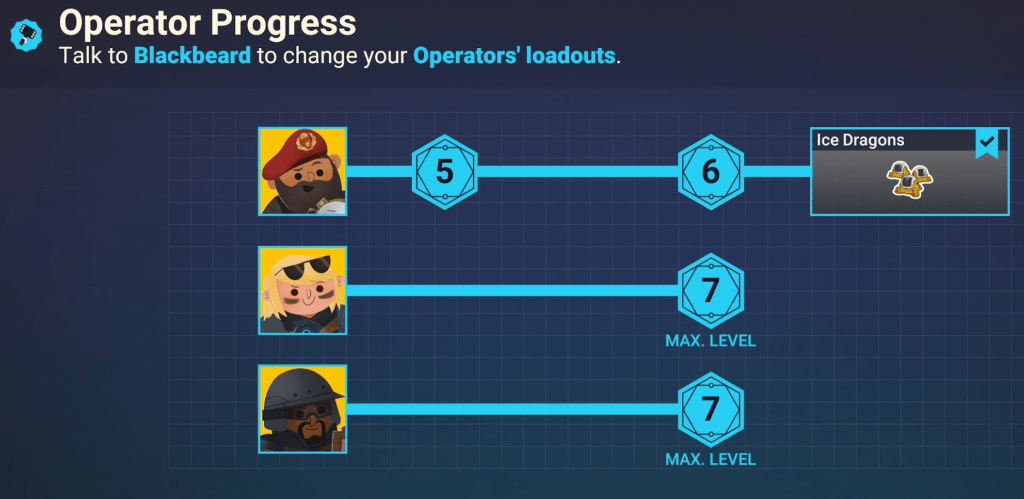
The choice of Operators shown to the player during gameplay is random from the pool of available operators. They are lost if the player dies.
Each operator brings something different to the table in terms of their skills. Generally they can be offensive, defensive or utility based.

New operators are unlocked by rescuing them from specific parts of the map by doing Operations.
Patches
Patches are the perks that the player can choose from while they are on Operations.
Normally, a player has the option of choosing between 3 options which are either Patches or Operators.

Patches can have a variety of effects such as,
- Stat Boosts
- Attack Modifiers
- HP Restores
- Currency Boosts etc.
Patches do not have any means or methods of improving either in-game or in the meta. Nor do they have any notable form of synergy with other patches or character classes.
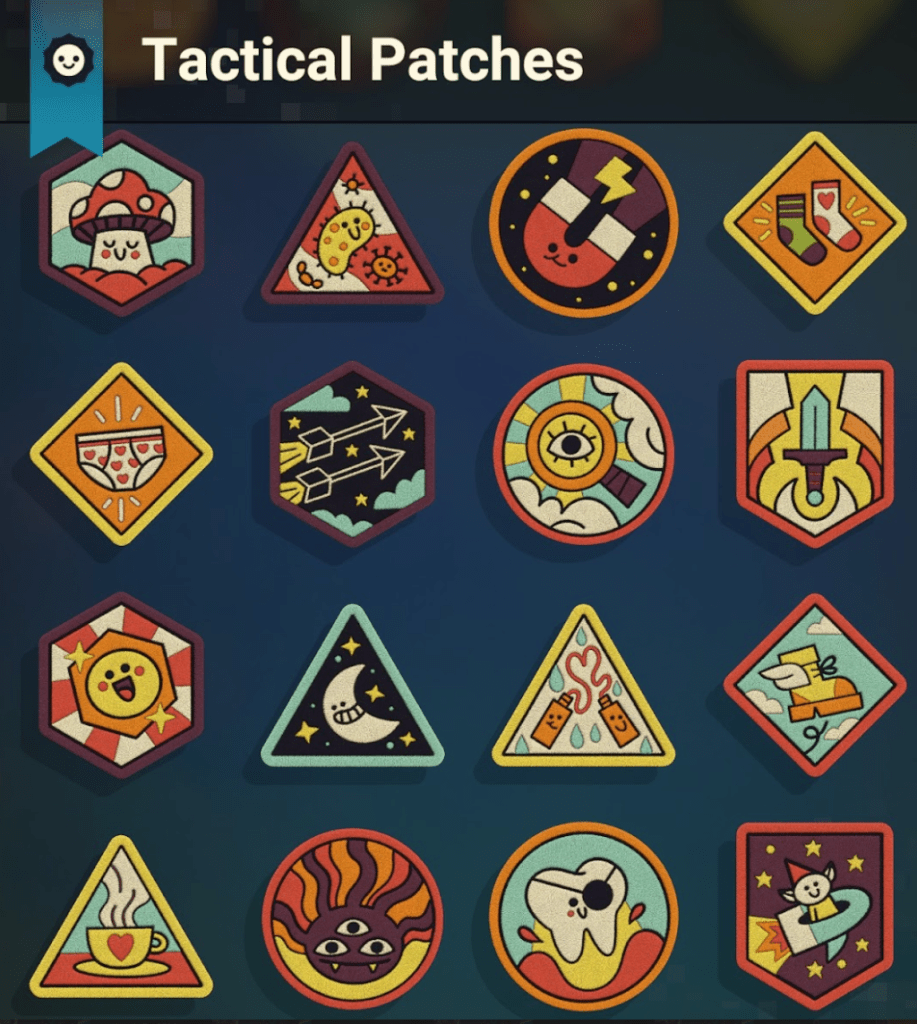
They are unlocked by completing objectives in the Map, and are added to the common pool of choices once unlocked.
Other Features
R6:SMOL being a single player premium game, does not try too much in terms of metagame features. The game employs some basic features in the meta for retention such as,
Books of Power
The Books of Power have different branches and their own progression similar to talent systems seen in other Roguelite games.
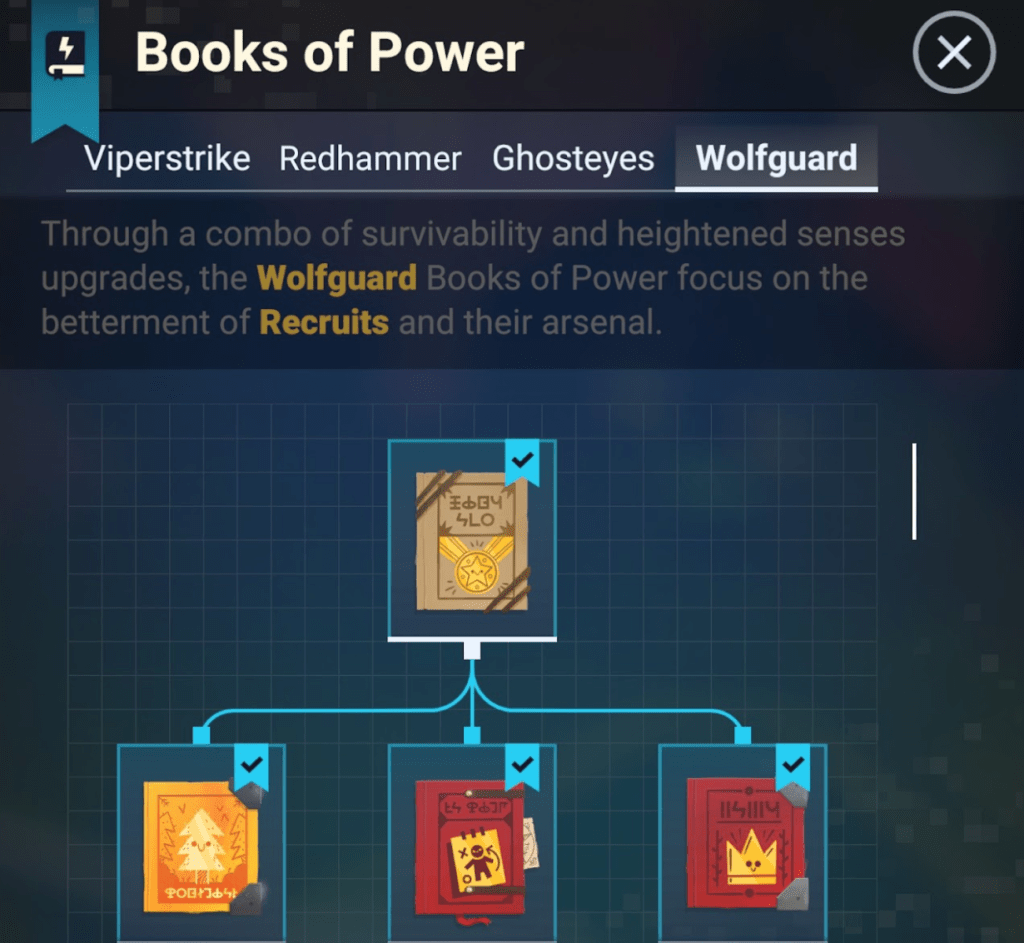
The Books of Power also grant other in-game perks such as more re-rolls of Perk choices, options for perks and character classes, increasing currency limits, extra lives and even modify Map choices by spawning Rest zones in the map.

Objectives
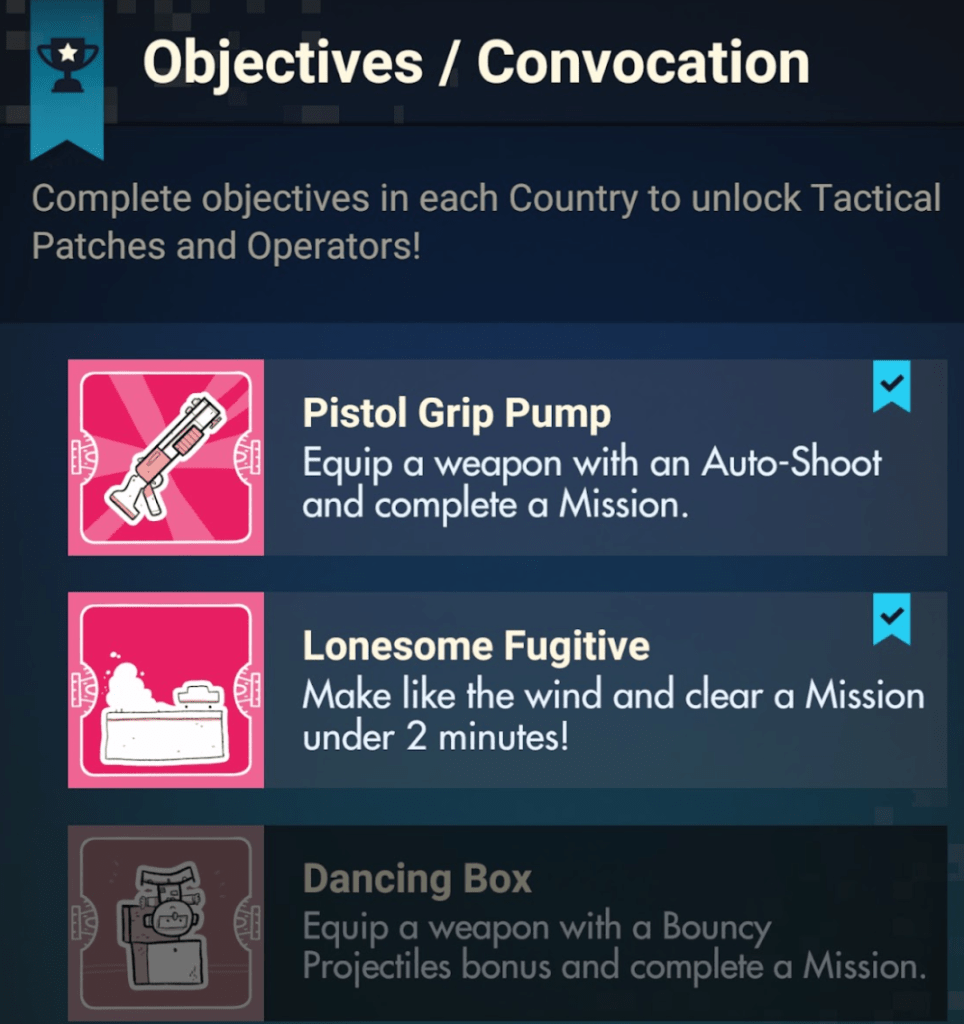
Objectives are goals tied to specific regions. They are used as gates to unlock new content in the map like Patches and Classes.
Bounties
These refer to global achievements that reward the player with Credits.

Bestiary and Progress Tracking
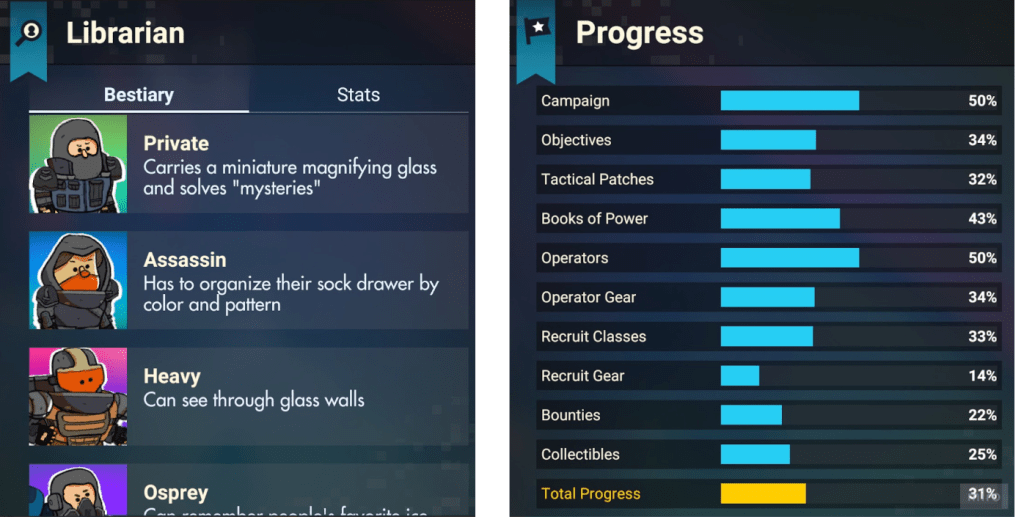
The game allows the player to track the different kind of enemies they have encountered and defeated along with their overall progress through the game.
Game News
The news section of the game serves as a source of in-game lore which can be uncovered by discovering Lore briefcases while on Operations.

Strengths and Drawbacks
Strengths
- Artstyle and Visual Appeal – The game is an absolute delight being an explosion of color, gunfire and flying doors accompanied by equally delightful sound design and writing. Clearly, a lot of love has gone into this game and it shows.
- Sweet spot of Complexity vs Approachability – It is obvious that this game was not meant to be taken seriously and so its approach to the mechanic complexity is just right for it to be easy enough to pick up while having enough content and gameplay depth to engage someone who is not used to the genre. This however comes at a cost.
- Uses IP Roots to be Unique – For what it is, R6:SMOL tries to be faithful to its IP as it provides a unique take on tactical shooters with destructible environments and squad gameplay. It does not try be what it is not, a hardcore FPS and instead embraces its arcade gameplay and mixes it up with roguelite mechanics for an explosive, fun and whimsical experience.
Drawbacks
- Lacking Strong Appeal to a Core Genre Audience – For the very reason why the game has a strong casual appeal, it holds the game back as it cannot fulfill the needs for either someone who enjoys shooters with precise, accurate gun mechanics (A typical R6 fan) or someone who enjoy the chaos and complexity that roguelite games can offer (Enter the Gungeon, Hades etc).
- Repetitive Gameplay – The biggest appeal of roguelite games is meaningful replayability that come from distinct playstyles arising from weapons/classes and emergent gameplay that is formed as a result of combinations of the roguelite skills. R6:SMOL falls short in both departments as neither the classes don’t feel as different enough nor is there any possibility of interesting in-game outcomes from Patch choices.
- Possibly Isolating Original Fans of the IP – Though the deviation from the core IP makes sense from the gameplay point of view, it can always be asked if Ubisoft could have tried something that appealed to the core-audience a bit more. A tactical shooter where both aiming and shooting can be automated isn’t much of a shooter anymore.
Conclusion
Rainbow 6:SMOL was a game that I picked up out of sheer curiosity that was originally piqued by the artstyle but ended up being a game that I spent a lot more time than I ever anticipated.
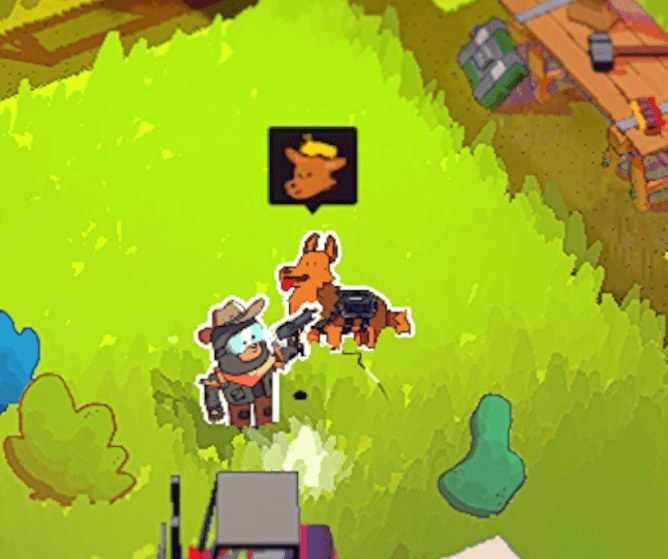
It is a game that managed to stand out from the swarm of other roguelite survivor-style games for all the right reasons and is a game that I would whole heartedly recommend for what it is, a simple, pure and fun experience that will leave a smile on your face.

 The Why Of Play